

Sarah Dickinson
29 November 2018
GitKraken picks up community demand to adopt snaps

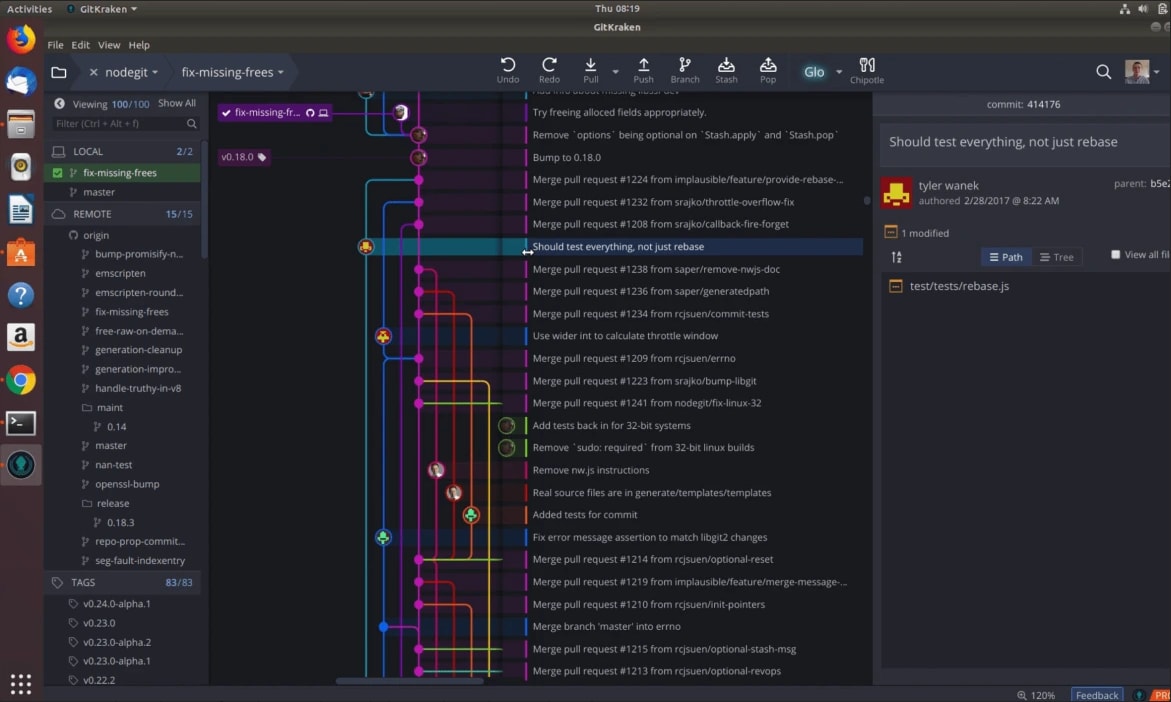
Used by the likes of Netflix, Tesla and Apple, GitKraken is the go-to home for developers who are looking for a more user-friendly interface for Git with integrations for GitHub, GitLab, Bitbucket and VSTS (Azure DevOps). Established a couple of years ago, GitKraken offers a Git Client for Windows, Mac and Linux, and Glo Boards for task and issue tracking—both available for teams or individuals, with the former available at an enterprise level, too. Earlier this month, GitKraken published their first snap which is already proving popular amongst Linux users.
James Quigley, Director of IT at Axosoft (makers of GitKraken), recently attended the Snapcraft Summit in London to progress the release of their snap. James explains how a member of their community kicked off GitKraken’s exploration of snaps…
“We had an issue with a dependency that was missing on some distros but not all. As a result, the community had built both a snap and a Flatpak to counter this. Martin Wimpress at Canonical reached out after seeing this and we started engaging,” explained James.
“Thanks to the initial legwork of the community, it was pretty easy for us to take the snap from there and integrate it into our processes. Obviously, being open source, we were able to see all the code that had been written to date,” added James. “We then tacked the snap on to the end of our CI pipeline, built the release and published into the store. There was no modification of the existing code needed, no additional pipelines.”
Previously, GitKraken had addressed the Linux community by offering a .deb and a tar.gz, but they wanted to extend their offering. Linux users make up a significant number of GitKraken’s user base because it is one of the only Git clients that works for Linux, as well as Windows and Mac.
Now that the snap is available in the Snap Store, James hopes it will become the default way for Linux users to start installing GitKraken and an opportunity which is currently untouched by their competition. By enabling GitKraken to reach more users, the snap availability will also help the company put more weight behind their efforts towards the Linux audience.
How does GitKraken think the official snap will benefit their Linux users? Ease of installation is one advantage, especially for those that aren’t super Linux savvy. James experienced this himself previously; “Installing Linux software hasn’t been easy traditionally – a tarball or zip is a ton of pain. Snaps help users who know how to use Linux but don’t want to manage all their software installations. It increases accessibility ultimately.”
The benefits have already begun to materialise for GitKraken themselves. “We’ve saved a lot of development time. Not only by coming to the Snapcraft Summit to accelerate our progress, but looking forward, the aim is to eliminate the need to target all the different platforms thanks to snaps’ cross platform approach,” said James.
It is this development time reduction which James advocates as the main reason for others to adopt snaps, and to start as early as possible. The automated CI/CD is also a big factor – currently GitKraken has to create and manage virtual machines (VMs) for each release. By moving to a snap only approach for Linux, the team will be able to build once and target all Linux users.


